Tasks
A task is a labeled training target. It references one or more records. The task class
is the type tag. You can use it as a search filter, for example search(task=ClassificationTask). The
instance carries the payload.
Every task has the same shape: inputs -> one typed answer. This shared frame lives on the base class. Every task, whatever its type, can carry these fields:
| Field | What it is |
|---|---|
record_ids |
The records the task is about, populated by add_task. |
prompt |
What the model is asked. None for an unprompted task. |
scope |
A Span narrowing the input to a region. None means the whole record. |
input_annotation_ids |
Annotations handed to the model as context. |
target |
The answer, typed by the subclass. |
target_annotation_ids |
The answer by reference: stored annotations rather than an inline copy. |
rationale |
A chain of thought to train on. |
from_tasks |
Source tasks this one was derived from. |
Because prompt and scope are shared, a task type is defined by only what kind of thing its answer is. The answer is a category, free text, a number, a set of regions, or a produced series. There are eight concrete types.
The Span primitive
A span is one region a task or annotation localizes. It has two independent traits: its shape (a point
or a half-open interval [start, stop)) and its frame (time or steps). The frame changes what the
numbers mean, so the frame is the type. The four concrete leaves are TimePoint, TimeInterval,
StepPoint, and StepInterval. Span, TimeSpan, and StepSpan are abstract bases you annotate with
(Span for any span), not construct.
A time span reads its bounds as whole microseconds on the source recording timeline. This is
the same frame a series' axis places its values in. So a time span stays meaningful on a windowed
record that starts partway into the recording. It covers the whole record when time_series_ids is
None, or a subset of series when it names them (a tuple of ids).
from timenet.types import TimeInterval, TimePoint

# an interval on one signal
TimeInterval.seconds(5.0, 8.0, time_series_ids=("vibration",))

# a point, every signal
TimePoint.seconds(1.2)
Besides seconds, both build from micros (whole microseconds). For a wall-clock moment, use
record.time_point(at) / record.time_interval(start, end), which read the record's own start_time.
A step span reads its bounds as ordinal indices into one series' own array. A step index means
nothing without a series to count on. So a step span names exactly one series via time_series_id
(a single str). It takes no unit builders. Construct it plainly. Steps exist for a series that has no
timeline at all: an ordinal sequence has positions but no clock. TSQA is such a series, an ordered
sequence of values with no calendar time. Steps 132 to 143 of one are this step interval:
The series' axis decides which frame fits, not the caller. A timeline axis (regular or irregular)
takes a time span. An ordinal axis takes a step span. add_task checks a span against the axis of every
series it names, and rejects a mismatch.
Spans cover both directions of time localization. A scope is a region given to the model. A
TemporalLocalizationTask target is a region the model must find.
ClassificationTask
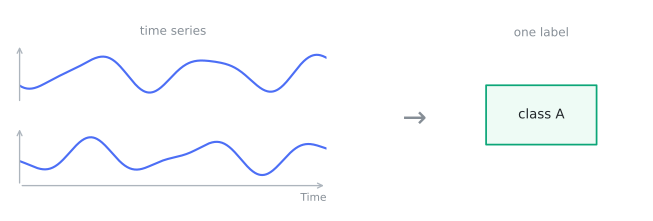
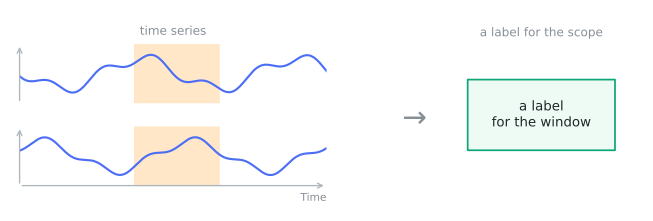
One categorical label. With no scope, the task labels the whole record. With a scope, it labels that
region. These are the same question asked of different amounts of input. So they are one type.
target_schema names the vocabulary of the label.
from timenet.types import ClassificationTask, TimeInterval

ClassificationTask(target="faulty", target_schema="condition")

ClassificationTask(
    target="fault_episode",
    target_schema="condition",
    scope=TimeInterval.seconds(5.0, 8.0, time_series_ids=("vibration",)),
)
AnswerTask
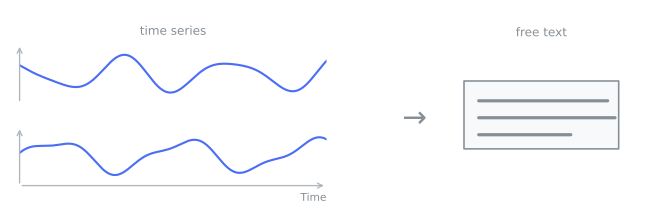
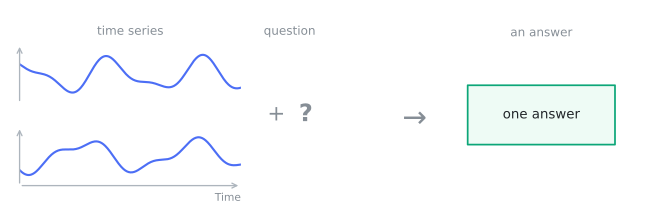
Free-form text out. With no prompt, the task is a caption. With a prompt, it answers a question.
from timenet.types import AnswerTask

AnswerTask(
    target=(
        "A 10-second vibration trace with rising amplitude and a periodic "
        "impact after 5 s."
    )
)

AnswerTask(
    prompt="Is the machine healthy?",
    target="No, a bearing fault is present",
)
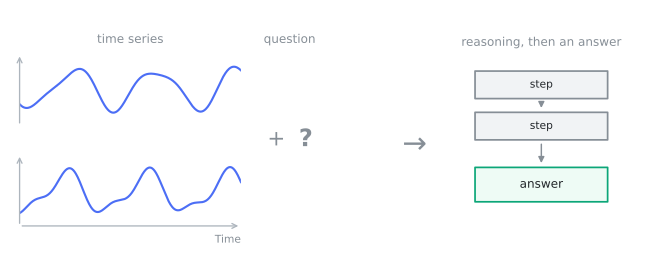
If you add a rationale, the same task supervises the reasoning and the answer. The field is on the base
class. So this is not a separate type: any task can carry a chain of thought.
from timenet.types import AnswerTask, ClassificationTask

base = ClassificationTask(target="faulty", target_schema="condition")

AnswerTask(
    prompt="Does this trace show a bearing fault? Walk through your reasoning.",
    rationale=(
        "The vibration amplitude grows steadily after 5 s and a sharp "
        "impact repeats once per shaft revolution. That periodicity matches "
        "the bearing's ball-pass frequency rather than imbalance, which "
        "would track shaft speed."
    ),
    target="Yes, an outer-race bearing fault",
    from_tasks=(base,),
)
ScalarPredictionTask
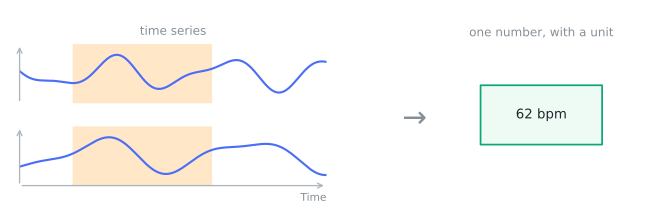
One number out. The task keeps the quantity and its physical unit as data. A regression target encoded as
a string in an answer task loses its type. A float with a unit keeps regression metrics, batching,
and unit-aware conversion simple.
from timenet.types import ScalarPredictionTask, TimeInterval

ScalarPredictionTask(
    target=62.0,
    unit="bpm",
    target_name="mean_heart_rate",
    scope=TimeInterval.seconds(0.0, 30.0),
)
TemporalLocalizationTask
Regions out: find where something happens, from a description of it. This task is the inverse of a scoped
ClassificationTask, which supplies the region and asks for its label. One type covers event detection,
segmentation, and change-point detection. They share this target: a tuple of TimePoint or
TimeInterval spans.
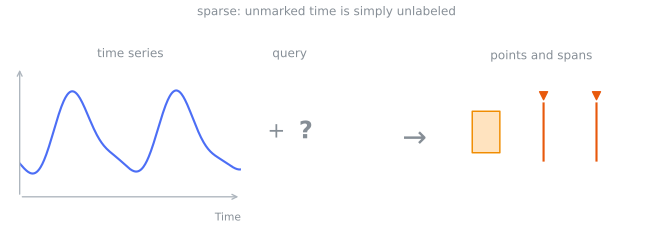
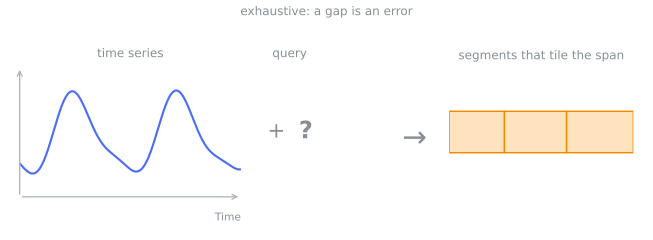
mode says whether unmarked time is allowed. SPARSE means only the marked spans are claimed (R-peaks).
EXHAUSTIVE means the spans must tile the region of interest, and a gap is an error (sleep staging).
from timenet.types import LocalizationMode, TemporalLocalizationTask, TimePoint

TemporalLocalizationTask(
    prompt="Locate all R-peaks in lead II.",
    mode=LocalizationMode.SPARSE,
    target=(
        TimePoint.seconds(1.20, time_series_ids=("II",)),
        TimePoint.seconds(2.05, time_series_ids=("II",)),
    ),
)

TemporalLocalizationTask(
    prompt="Segment the night into sleep stages.",
    mode=LocalizationMode.EXHAUSTIVE,
    # the answer is the stored annotations
    target_annotation_ids=("ann-n2-0007", "ann-n3-0008"),
)
ForecastingTask
Continue the context into the future. The future is either a whole separate record
(target_record_id) or a region of the record the task is attached to (target_span). The task sets
exactly one, never both and never neither. The record-id form references ids rather than raw arrays, so
context and horizon stay traceable to their dataset versions.
from timenet.types import ForecastingTask

ForecastingTask(
    context_record_ids=("2024-01-01",), target_record_id="2024-01-02"
)
target_span lets a single unsplit series carry a horizon, so a dataset can ship the raw recording
rather than a context/target pair. It is the region to predict: a TimeInterval on the recording
timeline, or a StepInterval on an ordinal series. It must be an interval, never a point. A point has
no duration, so it names no values. It needs an explicit scope for the context. The default
scope=None means the whole record, which includes the region to predict.
from timenet.types import ForecastingTask, TimeInterval

# forecast the last 12 s of a 144 s recording, given the first 132 s as context
ForecastingTask(
    scope=TimeInterval.seconds(0.0, 132.0),
    target_span=TimeInterval.seconds(132.0, 144.0),
)
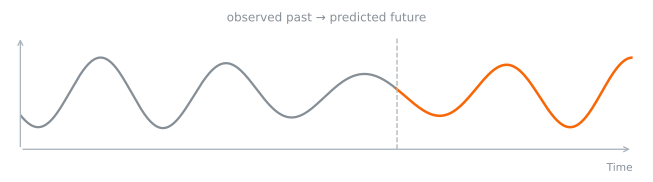
An ordinal series has no clock, so its horizon is named in steps instead. A purely ordinal sequence (order only, no calendar time) takes its last 12 steps as the horizon, given the first 132 as context:
from timenet.types import ForecastingTask, StepInterval

ForecastingTask(
    scope=StepInterval(time_series_id="sequence", start=0, stop=132),
    target_span=StepInterval(time_series_id="sequence", start=132, stop=144),
)
TSEditingTask
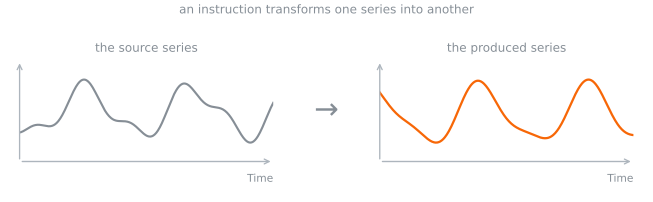
A series out: transform the source record into the target record, as the prompt instructs. This task
covers denoising, filtering, and deliberate corruption. Both sides of the edit are stored records.
from timenet.types import TSEditingTask

TSEditingTask(
    prompt="Remove the baseline wander.",
    source_record_id="ecg-raw",
    target_record_id="ecg-clean",
)
TSGenerationTask
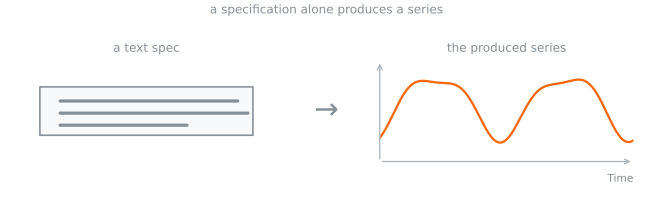
A series out from a text specification alone.
from timenet.types import TSGenerationTask

TSGenerationTask(
    prompt="Generate a 150 bpm sinus-tachycardia ECG, 10 s at 500 Hz.",
    target_record_id="ecg-synth-0001",
)
TSCorrespondenceTask
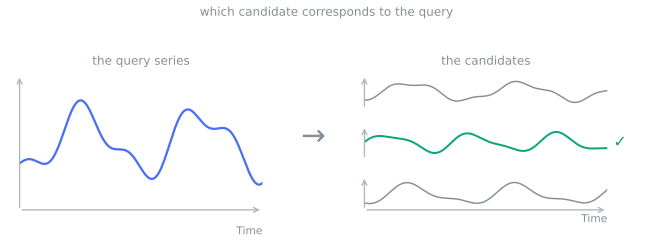
Relate one series to others. The task's record_ids are the query. candidate_record_ids is the pool
that the answer comes from. target names the correct one(s). If you leave the pool empty, the task is
open-ended.
from timenet.types import TSCorrespondenceTask

TSCorrespondenceTask(
    prompt="Which recording is most similar to this one?",
    candidate_record_ids=("rec-a", "rec-b", "rec-c"),
    target=("rec-b",),
)
Context or target
You can use an annotation two ways in a task:
- as context: something the model reads to help it answer (
input_annotation_ids), or - as the target: the thing the model must produce (
target_annotation_ids).
The same annotation can be the context for one task and the target of another. A task gives its answer
either inline in target or by reference in target_annotation_ids, never both. add_task rejects a
task that gives both. A pointer to stored annotations avoids a copy of, for example, a night of
sleep-stage intervals in a task row.
Tasks can also build on each other. With from_tasks, one task feeds into another. So a simple label can
seed a harder task about the same record. A few basic labels turn into many richer training examples.
flowchart LR
    A["an annotation"]
    C["a task that uses it as <b>context</b><br/><i>input_annotation_ids</i>"]
    T["a task that uses it as <b>target</b><br/><i>target_annotation_ids</i>"]
    A -->|as context| C
    A -->|as target| T
    B["a base task<br/><i>a simple label</i>"]
    R["a follow-up task<br/><i>from_tasks=(base,)</i>"]
    B -->|builds on| R