Datasets
A dataset is a versioned collection of records. Its address is org/name@version, for
example chengsenwang/tsqa@1.0.0. The id is a HuggingFace-style org/name pair. Dataset metadata
separates the TimeNet release from the original source:
| Field | Meaning | Example |
|---|---|---|
dataset_version |
Version of the converted TimeNet dataset | 1.0.0 |
source_revision |
Optional release, tag, or commit of the original source | v2.1 |
For example, a connector bug fix can produce TimeNet release 1.0.1 from the same source tag v2.1.
The dataset_version changes to 1.0.1, while source_revision stays v2.1.
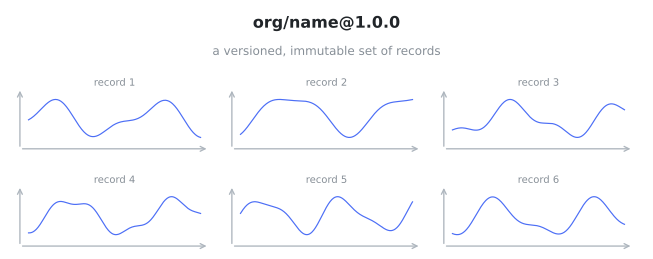
Versions are immutable
TimeNet commits a version atomically when its manifest.json lands. The version never changes after
that. A pinned @version gives you exactly those bytes. With no suffix (or @latest), you get the
newest committed version.
from timenet.client import TimeNet

client = TimeNet()
client.load("chengsenwang/tsqa")          # latest committed version
client.load("chengsenwang/tsqa@1.0.0")    # a pinned, immutable snapshot
Immutability makes full data lineage possible downstream. Every batch a model trains on traces back to the exact TimeF bytes of one version, not a moving target.
Parent dataset cards
A dataset card's parents maps local aliases to exact parent releases. A card declares each release
under one alias only. The output manifest stores a copy of each parent's card in parent_cards.
Each ParentDatasetCard holds that parent's metadata, whose dataset_id and dataset_version
identify the exact release.
For example, the alias ptbxl can name physionet/ptb-xl@1.0.0. Its parent card records that release
and its license, citation, access requirements, and other metadata. This copy lets readers inspect
the build's provenance without loading the parent dataset.
Where a dataset lives
A registry serves committed TimeF versions to the SDK. It can be a local directory, an S3 prefix, or a remote service. A registry never runs connector code. A local build output is also a registry, so the SDK can read it directly.