# Annotations
An annotation is side-information attached to a [record](records.md). Every annotation has two parts.
The **scope** says which signals and which point or window in time the annotation refers to. The
free-text **content** can be as short as a tag or as long as a paragraph of reasoning. One
`Annotation` class covers every case. The optional `span` says how the annotation sits in time.
A span is a `TimePoint` or a `TimeInterval`. Both read as microseconds on the source recording
timeline. The step frame (`StepPoint` and `StepInterval`, counted in a series' own ordinals) is for
[tasks](tasks.md) on an ordinal series. Annotations do not use it. The `Annotation` class is a
keyword-only frozen dataclass with `key`, `value`, `unit` and `description` fields. A connector
authors it directly, or subclasses it with field defaults for reuse.
## Record-wide facts
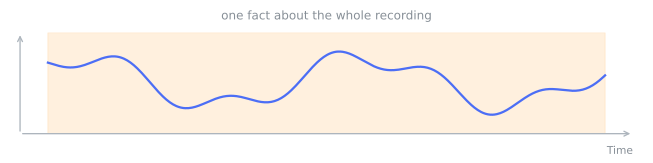
An `Annotation` with no `span` has no time reference. It describes the whole recording. It requires a
`value`. Record-level facts live here: a subject's attributes, the machine id, its firmware version,
an operating mode, or a single condition label. A record has no metadata field, so this is where such
context belongs. The fact travels with every window drawn later from the record.
```python
from timenet.types import Annotation
Annotation(key="age", value=54, unit="years")
Annotation(key="sex", value="F")
Annotation(key="condition", value="healthy")
Annotation(key="operating_hours", value=1200, unit="hours")
```
## One time offset
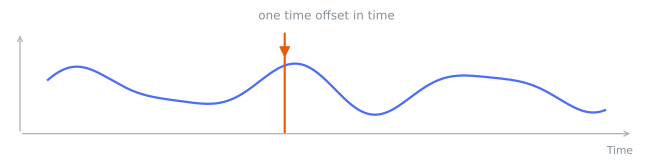
An `Annotation` whose `span` is a `TimePoint` marks one time offset on one or more signals. This
shape fits discrete events: a shock, a valve actuation, a detected spike. Points are cheap to store.
Detectors often produce them in bulk. Points then serve as anchors for downstream windowing. To
target specific signals, pass `time_series_ids`. To target the whole record, leave it `None`. A
`TimePoint` reads its offset as microseconds on the source recording timeline. `seconds()` converts
from recording seconds for you.
```python
from timenet.types import Annotation, TimePoint
Annotation(key="impact", span=TimePoint.seconds(4.2, time_series_ids=("vibration",)))
```
## A bounded window
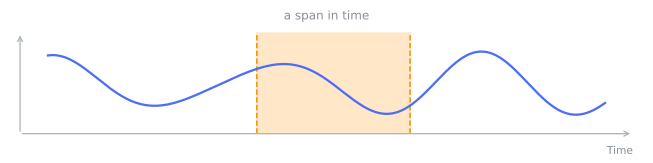
An `Annotation` whose `span` is a `TimeInterval` covers a start-to-end window on one or more
signals. This span is the most common one. The half-open range `[start, end)` must have an end that
exceeds its start. The full scoping grammar lives here: which signals by which time range. The
`value` and free-text `description` can carry the full reading of what happens in that window.
```python
from timenet.types import Annotation, TimeInterval
Annotation(
key="fault",
value="bearing fault",
span=TimeInterval.seconds(5.0, 8.0, time_series_ids=("vibration",)),
)
```
## Across signals
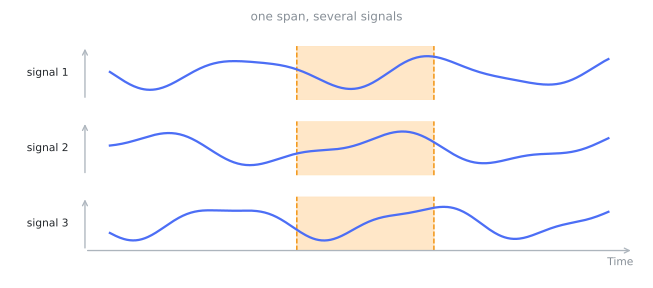
Annotations are not tied to one signal. A single event can span a vibration sensor, a temperature
probe, and a current sensor together. The shared timing indicates one physical process, not a
per-signal artifact.
A record holds a *list* of annotations. Several spans can sit on one signal. Windows can overlap or
nest. All three ways of sitting in time can coexist on one signal. The text field is free-form, so an
annotation can carry a multi-sentence reading rather than a label. This reading lets the annotation
become a reasoning target. That is the bridge to [tasks](tasks.md).